
Firm vs Soft Mattresses and How They Support You
Choosing a mattress isn't always simple, as the right level of firmness for comfort and support varies from person to person.
Read article
Preparing your best sleep…
Snooze Sleep Blog

Most people spend a third of their lives in bed, yet very few give their mattress the same careful consideration they'd give to a car or a home. They sit on a showroom display for a few minutes, maybe bounce a little, and make a decision that will affect their sleep for years.
But, without the right data, even the most well-intentioned mattress purchase can leave you waking up sore and tired.
That's where pressure mapping changes everything.
Pressure mapping is a diagnostic technology that uses a thin, sensor-embedded mat placed on top of a mattress. When you lie down, the mat captures a detailed visual display of exactly where your body makes contact with the surface and how much force is being distributed across those points.
The result is a color-coded image, typically shifting from cool blues and greens in low-pressure zones to warm oranges and reds where pressure is concentrated. It's a real-time picture of what's actually happening between your body and your mattress, and it tells you far more than any bounce test ever could.
When you lie down, gravity doesn't distribute your body weight evenly. Your hips, shoulders, lower back, and heels tend to carry a disproportionate load. If your mattress doesn't respond to those areas with the right level of support and cushioning, blood flow can become restricted, and your muscles stay engaged throughout the night while trying to compensate.
That's why you wake up tired even after a full night's sleep. That's why you toss and turn. And that's why your lower back aches before you've even had your morning coffee.
Pressure mapping removes the guesswork by showing you precisely where those problem areas are and, more importantly, whether the mattress you're considering actually resolves them.
When you visit a mattress store that uses pressure mapping technology, the process is straightforward. A sleep specialist will ask you to lie on a display mattress in your typical sleep position. Within moments, a map of your body's pressure distribution appears on a screen.
You'll be able to see in real time which areas of your body are under stress and which are well supported. Then, as you try different mattresses, you watch the map change. A mattress that's too firm might show intense red zones at the hips and shoulders. One that's too soft might show your midsection sinking without support. The right mattress produces a balanced map with even distribution and relief at the key pressure points.
This takes the "does this feel right?" guesswork out of the process and replaces it with something you can actually see and compare.
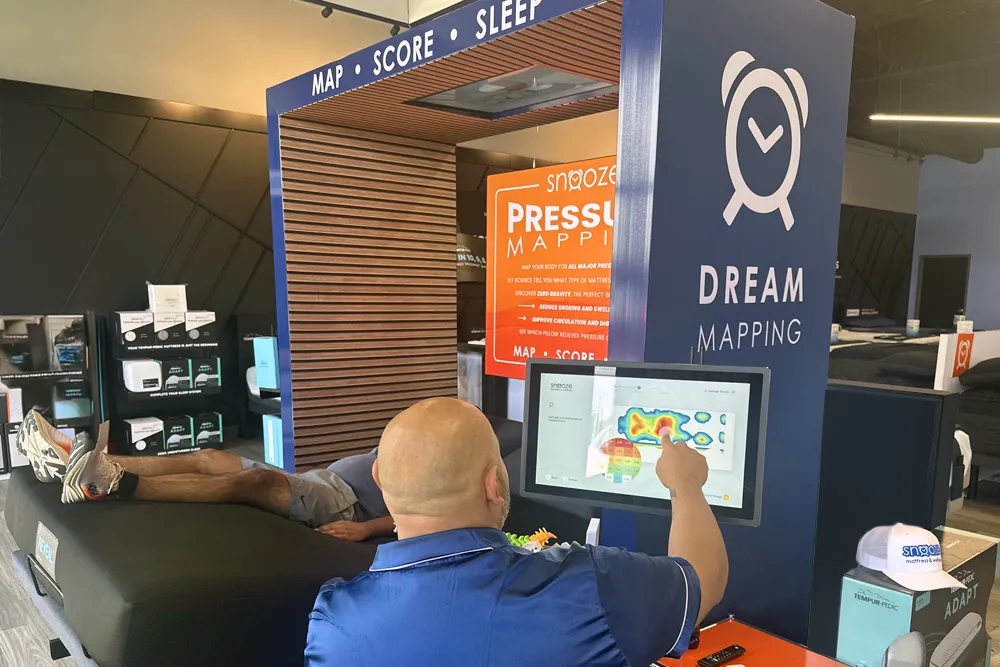
One of the most valuable aspects of pressure mapping is how it accounts for sleep position. Side sleepers and back sleepers have very different needs, and what feels fine while standing in a store can feel entirely different after an hour on your side.
This level of personalization simply isn't possible through trial and error alone.
Not all mattresses respond to pressure the same way, and that's clearly visible through a pressure map. Memory foam, latex, innerspring, and hybrid constructions all have distinct pressure distribution profiles.
Memory foam tends to contour closely to the body, spreading pressure across a wide surface area. It often shows a smoother, more even color distribution on the map. Latex offers a similar contouring effect with a more responsive feel, while traditional innerspring mattresses may show sharper pressure zones at bony prominences due to less adaptive cushioning.
This is particularly useful when comparing options across different price ranges. Even among luxury mattress brands, the construction and materials vary significantly, and what a brand labels as "medium firm" may behave quite differently under your specific body weight and shape. Pressure mapping cuts through the marketing language and shows you what the mattress actually does.
Poor sleep isn't just an inconvenience. Over time, chronic sleep disruption has been linked to a wide range of health concerns, from reduced cognitive function and mood instability to compromised immune response and increased physical recovery times.
Investing in a mattress that genuinely supports your body isn't a luxury. It's a health decision. Pressure mapping helps ensure that the investment you make actually delivers on its promise. It gives you confidence that the mattress you're taking home is suited to your body and your needs, not just the average person the manufacturer had in mind when they designed it.
If you're heading to a store that offers pressure mapping, a few simple steps will help you get the most from the experience.
Wear comfortable, form-fitting clothing so the sensor mat can get an accurate reading. Bring your partner if you share a bed, since their sleep position and body type will affect how the mattress performs for both of you. Many stores can run a dual-occupancy map to show how the mattress responds under two people simultaneously.
Come prepared to spend time in your actual sleep position, not just lying flat on your back. And don't rush the process. The map takes only a moment to generate, but comparing several mattresses side by side is where the real insight happens.
Ask questions. A good sleep specialist will walk you through what the map is showing you and help you understand what a healthy pressure distribution looks like for your body type and sleep style.
The right mattress doesn't just feel comfortable in a showroom. It works for your body, night after night. If you've been waking up sore or struggling to stay asleep, pressure mapping is worth experiencing for yourself.
Visit our local mattress store that offers this technology and see your sleep data in real time. Bring your questions and walk away with the kind of confidence that comes from making a decision based on information rather than instinct.
Yes. Pressure mapping responds to your actual body weight and shape in real time, making it equally useful for all types of bodies. The map reflects your individual distribution, not an average.
It's more commonly found at dedicated mattress and sleep specialty retailers. If finding a store near you that offers it matters, it's worth calling ahead to ask.
It can be a valuable tool for identifying where a current mattress may be contributing to discomfort. That said, it's not a medical diagnostic tool. If you have a specific condition, it's worth consulting a healthcare provider in addition to using pressure mapping to guide your mattress selection.
The underlying technology is made of sensor mats feeding into a visual display. Though the interface and how results are presented can vary, the core information you receive about your pressure distribution will be comparable.
The initial reading happens within seconds of lying down. A thorough session comparing multiple mattresses typically takes between half an hour and an hour, depending on what you want to evaluate.
Results are generally consistent for the same person on the same mattress. Minor variations can occur based on clothing or slight changes in position, or whether you've recently exercised. For the most reliable comparison, try to replicate the same position across each mattress you test.
Not at all. While side sleepers often have the most dramatic pressure concentrations to address, back and stomach sleepers benefit equally from understanding their distribution patterns and finding a mattress that supports their specific alignment needs.
Not sure which mattress is right for you?
Take the 60-Second Sleep Quiz →Real People. Real Results. Real Sleep.
Talk to our Sleep Specialists in El Paso. Get pressure-mapped, try the mattresses that fit your body, and ask about 0% financing — we treat every person who walks through our door like family.
10501 Gateway Blvd W Ste 16, El Paso, TX 79925 · Mon–Sat 10 AM–7 PM · Sun 11 AM–6 PM
Choosing a mattress isn't always simple, as the right level of firmness for comfort and support varies from person to person.
Read articlePicking a new mattress can feel like a bigger decision than it should be.
Read article